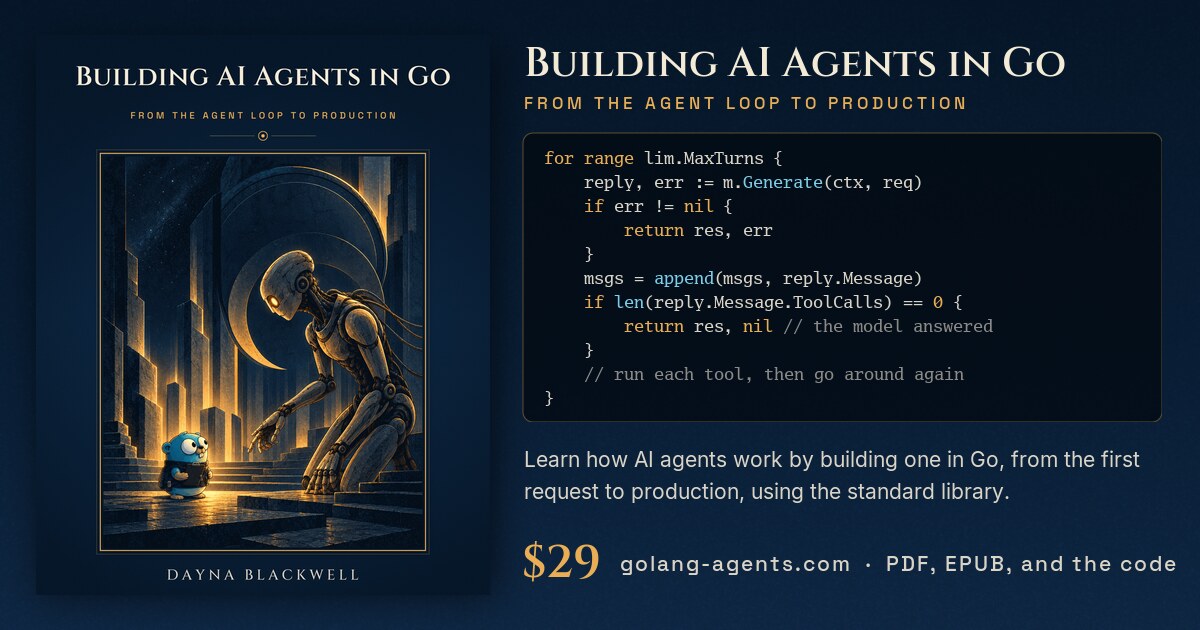
An agent is a model in a loop. My new book, Building AI Agents in Go, has you build the loop.
It is a book for Go developers who are new to language models. You build an AI agent one tested piece at a time with Go’s standard library (net/http, encoding/json/v2, context) and no framework, so you learn how agents, models and the harness around them actually work. You start with a 30-line loop and finish with a crash-triage agent for a real Go web service: it reproduces each bug, fixes it, and files one issue per cause, both as a command and as a service.
First edition (1.0), October 2026. 17 chapters in three parts, 776 pages, plus exercise notes, a glossary and an index. $29, one price, and every update of this edition is free. Buy it for $29, or start with the free 27-page sample.
What it covers
- The harness and its four-stage loop: build the request, call the model, run the tools, decide
- Inside the model: tokens, sampling, and why answers vary
- Tool calling on the wire, and designing tools a model uses well
- Context management, streaming, concurrency and MCP
- Providers and SDKs, retries, tracing and cost tracking
- Evals with sound statistics, graded by hidden tests across models
- Sandboxing, prompt-injection defenses and human approval
- Crash-safe runs that never repeat an action
- Go agent frameworks, compared against what you built
flowchart LR
req["Build the request"] --> call["Call the model"]
call --> tools["Run the tools"]
tools --> decide["Decide"]
decide -->|"more tool calls"| req
decide -->|"the model answered"| done["Return the result"]
style req fill:#3A4A5C,stroke:#6b7280,color:#f0f0f0
style call fill:#3A4C43,stroke:#6b7280,color:#f0f0f0
style tools fill:#4C4538,stroke:#6b7280,color:#f0f0f0
style decide fill:#4C3A3C,stroke:#6b7280,color:#f0f0f0
style done fill:#3A4A5C,stroke:#6b7280,color:#f0f0f0
Measured, from recorded runs
The book doesn’t ask you to take its claims on trust. Every result below comes from a recorded run:
- One sentence in a tool description decided the first move in 79 of 80 replies.
- Parallel agents were no faster than one, at about 25 to 60 percent more cost.
- The same agent, run twice, scored 15 points apart by chance.
- 910 crash scenarios, 0 duplicate actions with idempotency keys.
- The final comparison: anthropic/claude-haiku-5.5 70%, deepseek/deepseek-v4.1-flash 63%, openai/gpt-5.6-luna 20%.
Formats and code
- PDF in five reading themes (Light, Dark, Tokyo Night, Gruvbox Dark, Catppuccin Latte), EPUB, and a code zip.
- Code: Go 1.27, standard library first. Every example runs offline with no API key. Apache 2.0, on GitHub at blackwell-systems/go-agents-book-code (tag v1.0).
Links
- Buy, $29: blackwellsystems.gumroad.com/l/go-agents
- The book and its companion guide: golang-agents.com (also golangagents.com)
- Free sample, 27 pages: Light or Dark
- Code: github.com/blackwell-systems/go-agents-book-code